How to Treat Ota Nevus Combined with Melasma Using Laser Therapy Without Triggering Irritation?
In clinical practice, patients often present with more than one type of facial pigmentation, and mixed pigmentation is actually the most common scenario. Among these, melasma and Ota nevus frequently appear together. When both conditions coexist, how should treatment strategies be chosen to achieve the best results? Should the energy settings be high or low? And most importantly, how can we prevent post-treatment irritation or worsening of pigmentation? Let’s explore the answers together.
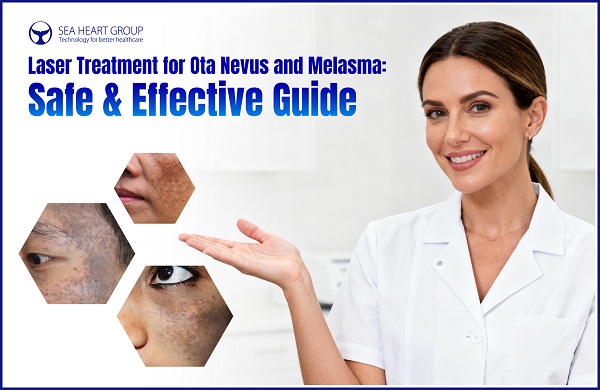
01. Differentiating Melasma and Ota Nevus
Ota nevus typically appears between the ages of 25 and 45, which overlaps with the common onset age of melasma. Their similar appearance often causes confusion, but several factors help in distinguishing them:
Location:
Ota nevus commonly appears on both sides of the forehead, often extending into hair-bearing areas.
Melasma usually occurs in the center of the forehead or above the eyebrows and does not affect hair-bearing regions. Under-eye Ota nevus manifests as scattered small patches, while melasma follows the orbital contour in diffuse, nail-sized patches.
Color Differences:
Ota nevus: grayish in tone, usually subtle.
Melasma: yellow-brown, often with a reddish undertone.
Shape:
Ota nevus: small, spot-like lesions, occasionally merging into diffuse patches.
Melasma: larger, diffuse lesions.
Changes Over Time:
Melasma worsens in summer or with sun exposure, while Ota nevus usually remains unchanged.
Common Sites:
Ota nevus is often seen on the cheekbones, lower eyelids, outer forehead, lateral eyelids, nasal wings, and nasal root.
02. Treatment Strategies for Ota Nevus Combined with Melasma
When treating patients with both melasma and Ota nevus, determining the treatment sequence is crucial.
Step 1: Control melasma first.
Ota nevus requires high-energy treatment, which can easily aggravate melasma, making it darker or causing post-inflammatory hyperpigmentation (PIH). Therefore, stabilizing melasma must take priority.
Step 2: Combined therapy approach.
Start with topical hydroquinone or oral tranexamic acid to stabilize pigmentation.
Combine with optimized pulsed light (OPT) or chemical peels.
Once melasma is visibly improved, follow with Q-switched 1064nm or 694nm laser for Ota nevus.
Clinical research has shown that using OPT combined with Q-switched 694nm laser significantly improves both conditions. In one study, after one year of follow-up, only 7.1% of patients experienced melasma recurrence, demonstrating both safety and efficacy. Another approach uses OPT combined with picosecond lasers, delivering visible improvements without triggering melasma relapse.
03. Choosing the Right Energy Parameters
Energy settings play a decisive role in treatment outcomes.
Low-energy sweeping with large spot size (Q-switched 1064nm):
Spot size: 6–8mm
Energy density: 1.0–1.5 J/cm²
Apply until mild redness appears.
After 2–4 months of repair-focused treatment and barrier stabilization, higher precision energy can be used for Ota nevus.
Key principle:
Avoid overtreatment (bleeding, scabbing), which can worsen melasma.
Gradual improvement with low-energy, multiple sessions reduces risks while improving both melasma and Ota nevus.
Alternative methods include:
Picosecond laser (755nm): Precisely removes Ota nevus while minimizing melasma irritation.
Topical agents: Hydroquinone, azelaic acid, kojic acid.
Oral medications: Tranexamic acid, glutathione, traditional Chinese medicine.
Intradermal injections: Direct drug delivery into lesions to improve pigmentation and reduce rebound.
Final Thoughts
When treating Ota nevus combined with melasma, dermatologists must carefully balance laser wavelength, spot size, and energy density to achieve results while avoiding post-inflammatory hyperpigmentation. The safest approach is to start with melasma control, then gradually target Ota nevus with tailored laser settings.
This patient-centered strategy not only ensures safety but also significantly improves skin clarity and overall satisfaction.

 English
  Español
  Русский


 Dubai Derma 2026
 BeautyEurasia 2026 in Turkey
 Best Body Slimming Machines for Clinics in 2026
 Top 10 Aesthetic Equipment Suppliers in China (2026 Edition)

